

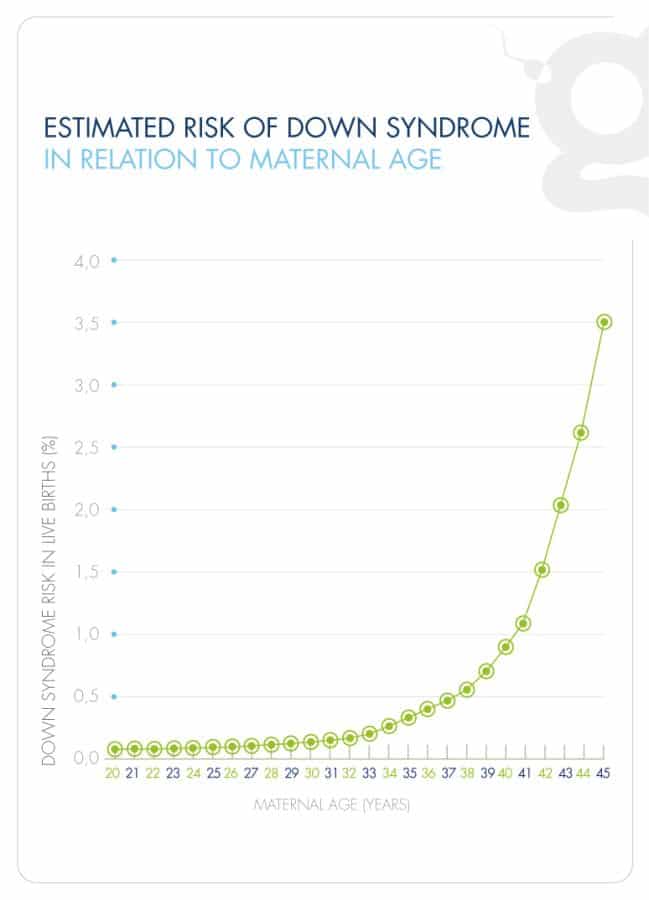
We know that as maternal age increases, the probability of the baby having a genetic anomaly also rises.
The following chart shows the estimated risk of Down syndrome by the mother’s age:
What is Clarix and what is it for?
Clarix is a noninvasive prenatal genetic test that analyzes your baby’s health and tells you its sex from week 10 of pregnancy. It works the same whether your pregnancy was natural or via assisted reproduction.
At Ingenes we perform this test with no risk to you or your baby. With just 10 mL of your blood, we obtain cell-free fetal DNA and achieve 99% accuracy.
How does the Clarix test work step by step?
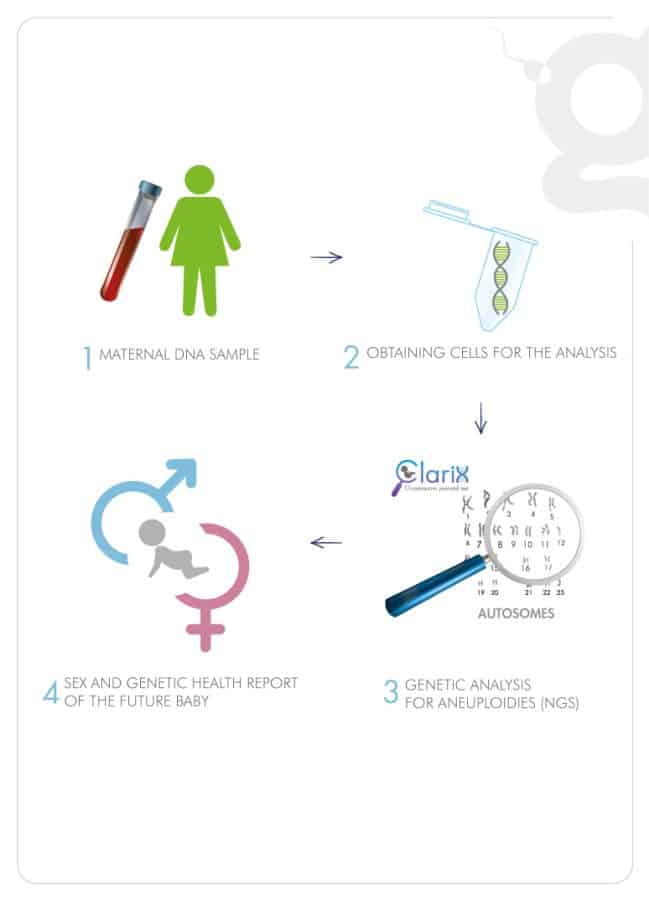
- We draw 10 mL of maternal peripheral blood.
- We isolate and sequence the cell-free fetal DNA.
- We detect the most common aneuploidies (trisomy 21, 18, and 13).
- We provide you with a report showing results and 99% accuracy.
Who is Clarix recommended for and when to take it?

Clarix is ideal for:
- Pregnant women (natural or after assisted reproduction).
- Those aged 35 or older with higher risk of chromosomal anomalies.
- Those who want to know fetal sex from week 10.
- Patients who did not undergo PGT-A during their treatment.
In what formats is the Clarix test offered?

Contact us and we will create your personalized plan so you feel confident about your baby’s health. Also learn about PGT-A for extra peace of mind.
Importance of early genetic diagnosis
Detecting anomalies noninvasively gives you information to make calm decisions, reduces anxiety, and allows proper follow-up. You avoid risks associated with invasive tests like amniocentesis.
With Clarix you receive fast, accurate results to plan everything with your doctor. Do not self-medicate without consulting a specialist first.
FAQ about Clarix and genetic anomaly detection
1. Is Clarix safe for me and my baby?
Yes. It is 100% noninvasive: only a 10 mL maternal blood sample is required, with no risk of miscarriage or complications. Massively parallel sequencing provides 99% accuracy for trisomies.
2. What anomalies does Clarix detect?
It detects trisomies 21 (Down), 18 (Edwards), and 13 (Patau). Depending on the format, it may include sex chromosome anomalies or microdeletions. For a more comprehensive analysis, consider PGT-A.
3. When do I get the results and how?
Within 5–7 business days you will receive a detailed report by email and can schedule a consultation with our maternal-fetal medicine specialists to answer questions and plan follow-up.
4. Do I need fasting or special preparation?
No fasting or special preparation is required. You only need to provide a 10 mL blood sample at our lab or affiliate center. If you have allergies or medical conditions, mention them beforehand to ensure your comfort.
References
- American College of Obstetricians and Gynecologists. (2022). Noninvasive Prenatal Testing. Retrieved from https://www.acog.org
- MedlinePlus. (2023). Genetic Testing and Pregnancy. https://medlineplus.gov/genetictestingandpregnancy.html
- Lo, Y. M., & Chiu, R. W. (2017). Cell-free DNA sequencing in maternal plasma for prenatal diagnosis. Clinical Chemistry, 63(1), 49–58. doi:10.1373/clinchem.2016.260226
- Gregg, A. R., et al. (2016). Fetal Aneuploidy Detection: ACOG Practice Bulletin. Obstetrics & Gynecology, 127(5), e123–e137. doi:10.1097/AOG.0000000000001610
We’re with you on this journey: if you have questions or concerns, always consult an assisted reproduction specialist for proper guidance and support.